West Gallery Music
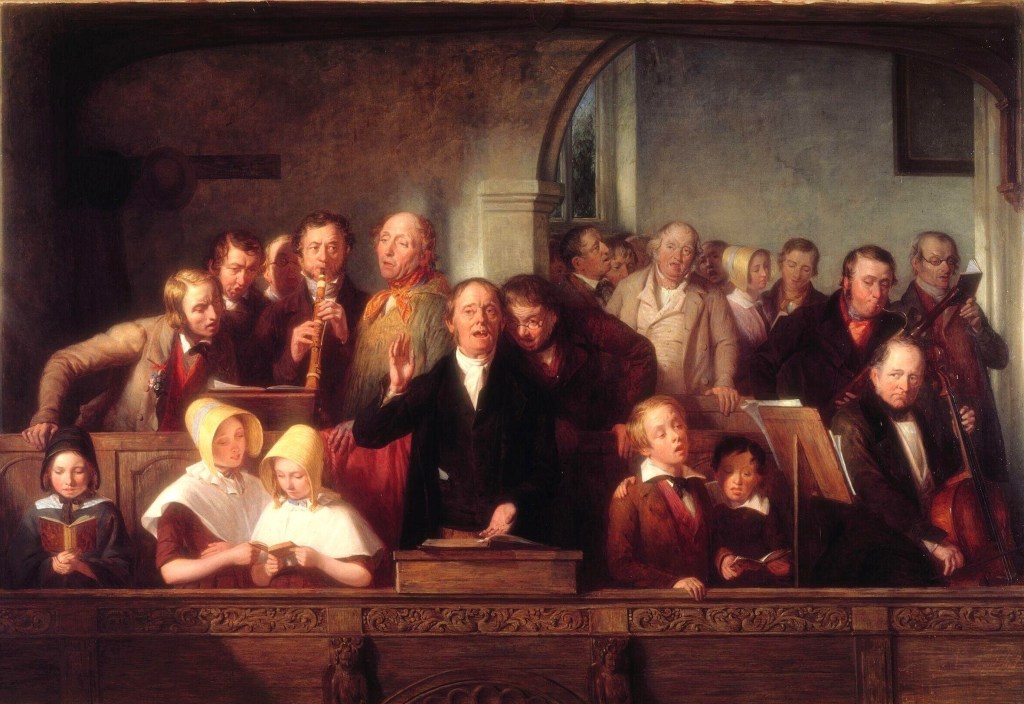
The Village Choir by Thomas Webster (1800-1886)
©Victoria and Albert Museum, London
The musical tradition we now call West Gallery Music arose in rural churches following the restoration of the monarchy in 1660, after which music was allowed back into church worship. At the time it was known simply as psalmody, as initially only words from the Bible were deemed acceptable to be heard in church. The psalms were set metrically so that they could be sung; there were two versions – the Old Version (OV) by Sternhold and Hopkins published in 1563, then a New Version (NV) by Tate and Brady from 1696. Gradually, people such as Watts and the Wesleys began writing hymns, either based on the psalms or just as religious texts.
People who played instruments will have continued to do so, even during the prohibition and thus were available to play in church when needed. Fiddles, flutes, clarinets, oboes and – as church funds allowed – bass instruments such as bassoon, bass viol, serpent were all represented. Singers were recruited to support the psalm singing which helped to relieve the tedium of long, spoken services
In order to accommodate the singers and instrumentalists who accompanied them, galleries were erected at the west end of churches, some of which are still visible, although they now often contain the organ which supplanted the quire, the term used to distinguish the west gallery groups from the surpliced choirs which succeeded them.
From being a simple sung rendition of the psalm of the day, the music grew to a full four part harmony, often with fuguing entries of the different parts, which made it more difficult for the congregation to join in. The quires often had their own ideas of what to sing that differed from those of the local vicar. This, together with reforming concepts within the Church of England, led to the expulsion of the quires and their replacement with organs and choir boys under the tutelage of the vicar’s wife.
This robust, joyful style of music which our great-great-great-great-grandparents may have sung lasted from ca. 1700 to ca 1850. Many of the exponents then migrated to the Methodist chapels where it continued to be sung. Some hymns are still in the repertoire today.
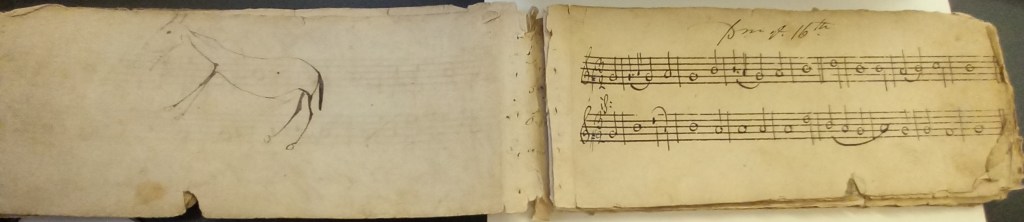
Example of Colby manuscript in the Manx Museum Douglas Isle of Man after the village ‘Colby’, Arbory, Isle of Man where they were discovered.

